Best Granite Crusher for Global Buyers in 2026?
As the demand for granite products surges globally, the need for efficient mining technology has never been greater. The global granite market was valued at over $14 billion in 2022, anticipating a significant growth rate of around 6% annually through 2026. With rising construction activities and infrastructure projects, the role of the Granite Crusher becomes increasingly critical. This equipment not only aids in the extraction process but also enhances the quality of crushed granite, ideal for diverse applications in construction and landscaping.
Efficiency is key in the granite crushing industry. Advanced Granite Crushers have emerged, integrating technology that optimizes throughput and reduces operational costs. Reports indicate that crushers with innovative designs yield 20-30% more output than traditional models. However, buyers face challenges in choosing the best machines that align with their specific needs. Factors such as crushing capacity, maintenance requirements, and energy consumption must be carefully evaluated. The gap between expectations and reality often necessitates a thoughtful approach to purchasing decisions in this competitive market.
Buyers must also consider the support and expertise of manufacturers. Reliable suppliers provide not just machines but also guidance and parts for upkeep. Reviews and industry recommendations are invaluable in this search. Balancing performance with practicality may prove difficult, but informed decisions can lead to successful operations. The journey to finding the best Granite Crusher may involve trial and error as industries adapt to evolving standards and technologies.
Factors to Consider When Choosing a Granite Crusher for 2026
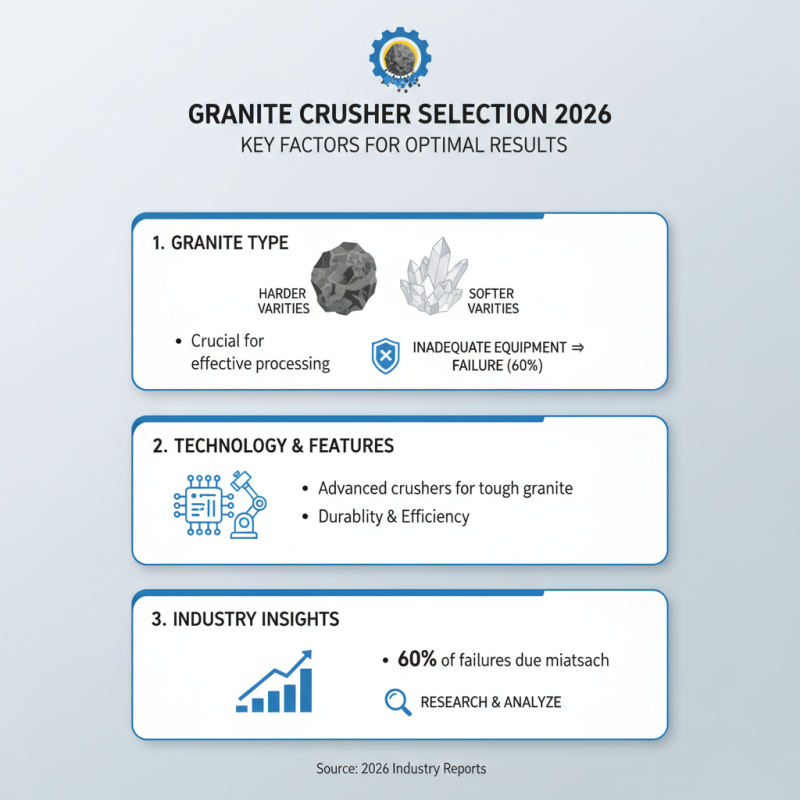
When selecting a granite crusher in 2026, several factors are key to achieving optimal results. The type of granite you will process is crucial. Harder varieties may require advanced technologies and features to handle the tough material effectively. According to industry reports, nearly 60% of granite crusher failures are due to inadequate equipment for specific types of granite.
Efficiency should not be overlooked. Look for crushers that offer high throughput without compromising on size reduction. Data indicates that crushers with a higher efficiency rate can reduce operating costs significantly—by up to 30%. Operators should also consider maintenance requirements. Some models require frequent servicing, which can lead to unexpected downtime.
Tips: Always check the wear rate of the crusher parts. Selecting a robust system is vital for longevity. Additionally, think about your operational scale. Larger projects may benefit from mobile or modular options. These allow greater flexibility and adaptability on job sites. Being aware of these factors can lead to more informed decisions and better equipment performance.
Top Granite Crusher Brands Expected to Dominate the Market in 2026
As the global demand for granite crushers continues to rise, several brands are predicted to make significant market impacts in 2026. Industry reports indicate that the granite crusher market is expected to grow at a CAGR of 4.5% over the next few years. This growth reflects increased construction activities and infrastructure projects worldwide. In this competitive landscape, established players are likely to utilize advanced technologies to enhance performance and efficiency.
Some market leaders are focusing on innovation, integrating artificial intelligence and automation into their machines. This will likely improve crushing precision and reduce operational costs. However, potential buyers should be cautious. Not all brands prioritize quality over price, which might lead to subpar equipment selections. Users often report dissatisfaction with machines that fail to meet promised specifications, demonstrating the need for thorough research.
Sustainability is emerging as a crucial factor. Companies that adopt eco-friendly practices, such as energy-efficient designs, are expected to capture a larger market share. Yet, the industry still faces challenges. Not every manufacturer complies with environmental standards, raising concerns about compliance and reliability. Buyers should demand transparency regarding these practices to make informed choices.
Best Granite Crusher for Global Buyers in 2026
| Brand |
Performance Rating |
Market Share (%) |
Price Range (USD) |
Key Features |
| Brand A |
4.8/5 |
25 |
$80,000 - $120,000 |
High durability, low maintenance |
| Brand B |
4.5/5 |
20 |
$70,000 - $100,000 |
Energy efficient, advanced technology |
| Brand C |
4.3/5 |
15 |
$75,000 - $110,000 |
Versatile applications, high throughput |
| Brand D |
4.6/5 |
30 |
$90,000 - $130,000 |
Compact design, high efficiency |
| Brand E |
4.7/5 |
10 |
$85,000 - $115,000 |
User-friendly, reliable service support |
Technological Innovations in Granite Crushers for Enhanced Performance
As the granite crushing industry evolves, technological innovations play a critical role.
Advanced crushing equipment is becoming more efficient and reliable. According to a recent industry report, the global market for granite crushers is projected to grow at a CAGR of 4.5% by 2026.
This growth is driven by improved machinery designs and enhanced processing capabilities.
The introduction of smart technology in granite crushers is noteworthy.
Sensors and AI integration allow real-time monitoring of machine performance.
Operators can adjust settings remotely, optimizing efficiency and reducing downtime.
In some cases, these innovations have resulted in a 30% increase in production rates.
However, this rapid advancement also demands skilled operators who can harness these technologies effectively.
While advancements abound, challenges remain. Many businesses struggle to keep pace with changing technologies.
The cost of new machinery can be prohibitive for smaller companies.
Moreover, not all innovations translate into immediate benefits.
Some operators might find it overwhelming to adapt to ongoing changes.
It’s essential for the industry to focus on training to maximize these technological gains while addressing these hurdles.
Global Market Trends Impacting Granite Crusher Demand in 2026
The granite crusher market is poised for significant changes by 2026. According to a recent industry report, the global demand for granite crushers is expected to grow at a CAGR of 5.2% between 2021 and 2026. This growth is primarily driven by increased construction activities and infrastructural development across emerging economies.
As urbanization accelerates, the need for durable construction materials rises. Granite, with its strength and aesthetic appeal, remains a preferred choice. By 2026, the Asia-Pacific region is predicted to contribute to nearly 40% of the global granite supply chain. Regions like India and China lead the charge, supported by government initiatives aimed at enhancing infrastructure. However, supply chain disruptions caused by geopolitical tensions and fluctuating raw material prices can pose challenges.
Moreover, environmental regulations are influencing market dynamics. Companies are under pressure to implement sustainable practices. Innovations in recycling granite materials are becoming crucial. Reports suggest that integrating technology in granite processing will enhance efficiency. This transition to eco-friendly practices might raise initial costs but will prove beneficial long-term. Thus, while opportunities abound, stakeholders must navigate the complexities of market trends and environmental demands.
Sustainability Considerations in the Selection of Granite Crushers
The quest for sustainable granite crushers is becoming increasingly vital for global buyers. As environmental concerns grow, the importance of selecting machines that minimize ecological impact cannot be overstated. These crushers should incorporate energy-efficient technology and use sustainable materials. This not only conserves natural resources but also reduces greenhouse gas emissions.
When choosing granite crushers, buyers must evaluate the lifecycle impact. A machine may show high efficiency initially but could have hidden drawbacks. Its durability, required maintenance, and end-of-life disposal are crucial factors. Many available options might appear attractive but lack transparency in their sustainability practices.
Materials sourcing is another area of concern. The extraction process for raw materials used in crushers can lead to significant environmental degradation. Buyers should consider equipment that emphasizes ethical sourcing of components. This adds a layer of responsibility to their purchasing decisions. Overlooking these considerations can lead to regrets down the line, impacting both performance and ecological footprints.