- Home
- Products
- Projects
- Solutions
- News
- Services
- About Us
- Blog
- Contact Us
Inquiry
Form loading...
A Mining Jaw Crusher is a primary machine that reduces large, blasted rocks into manageable pieces. It works through controlled compression, not impact. A fixed jaw supports the material, while a moving jaw presses against it repeatedly. The moving jaw follows an elliptical path, driven by an eccentric shaft and powerful bearings.
“The first step in mineral liberation is crushing,” explains Professor Barry A. Wills, a respected authority in mineral processing. His observation captures the crusher’s role clearly. Before grinding or separating valuable minerals, the ore must reach a suitable size. In a quarry, this may mean turning a 900-millimeter boulder into fragments below 150 millimeters.
The operator adjusts the closed-side setting, or CSS, to control the product size. Smaller settings usually create finer material, but they can increase power demand and wear. The toggle plate transfers crushing force and provides a vital safety function. If uncrushable material enters the chamber, it may release under excessive pressure.
That detail matters.
In real operations, feed moisture, rock hardness, and chamber design change performance. A dry limestone feed behaves differently from wet, sticky clay-bearing ore. Operators also inspect jaw plates, cheek plates, lubrication points, and discharge flow. Small warning signs can become expensive failures.
A Mining Jaw Crusher is powerful, but it is not automatically efficient. Correct feeding, regular maintenance, and realistic production targets matter more than size alone. Some explanations make crushing sound simple. Field conditions prove otherwise.
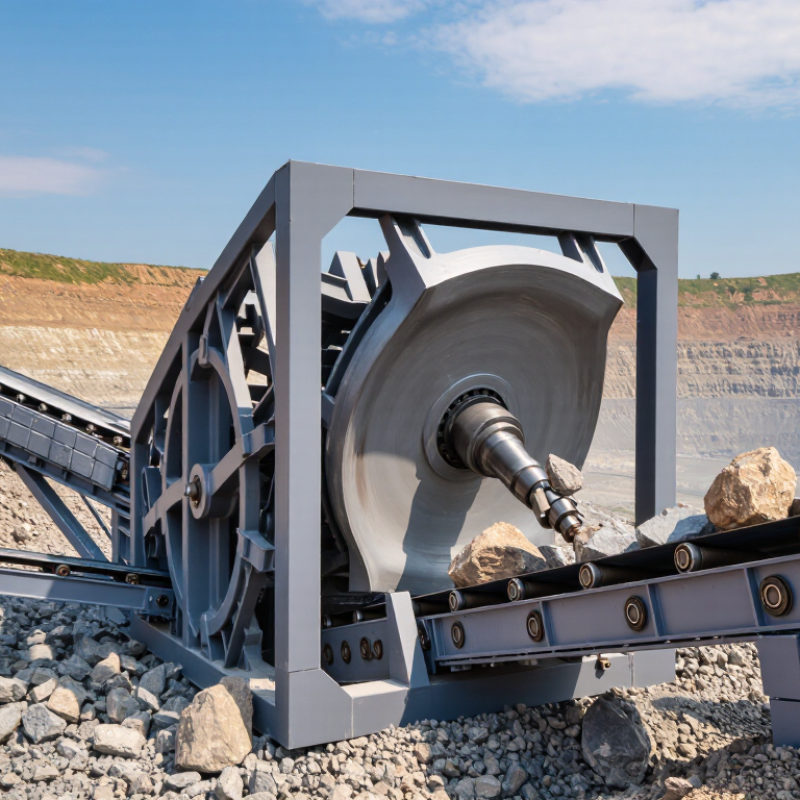
A mining jaw crusher is a primary crushing machine for hard, abrasive materials. It uses two metal plates, called jaws, to break ore and rock. One jaw stays fixed. The other moves back and forth against it. Large feed enters from the top and leaves through a smaller bottom opening.
The machine works through compression, not cutting. An eccentric shaft drives the moving jaw, while a flywheel stores rotational energy. Each closing stroke fractures the material along natural weaknesses. Operators adjust the discharge setting to control particle size. A wider setting produces larger fragments. A tighter setting creates finer output, but it can increase wear and energy demand. Keep feed steady.
The USGS Mineral Commodity Summaries 2024 reported about 1.5 billion metric tons of crushed stone produced in the United States during 2023. That scale shows why dependable primary crushing matters, although the figure covers the industry, not jaw crushers alone. The U.S. Geological Survey also identifies construction aggregates as essential materials for roads, buildings, and infrastructure. In field operations, technicians inspect jaw plates, bearings, belts, and lubrication systems daily. Dust, moisture, and uneven feed can reduce performance. A jaw crusher may appear simple, but site conditions are rarely simple. It is not always the best secondary crusher. Proper sizing still requires testing the ore, measuring moisture, and reviewing actual production data.
| Data Dimension | Typical Information | How It Relates to Operation |
|---|---|---|
| Machine Type | Primary compression crusher | It reduces large pieces of mined rock by applying compressive force between two crushing surfaces. |
| Main Components | Fixed jaw, movable jaw, pitman, eccentric shaft, toggle plate, flywheel, frame, and discharge opening | These components support the crushing chamber, transmit motion, and control the size of the discharged material. |
| Crushing Motion | Reciprocating movement of the movable jaw | The movable jaw advances toward the fixed jaw to crush material and then moves away to allow the material to fall downward. |
| Operating Principle | Compression between a fixed jaw and a movable jaw | Rock is gripped, compressed, fractured, and released during repeated cycles. |
| Typical Feed Material | Run-of-mine ore, hard rock, blasted rock, concrete, and recycled mineral material | The machine is commonly used when large, irregular feed must be reduced before secondary crushing or processing. |
| Feed Size | Often several hundred millimeters to more than 1 meter, depending on crusher size and design | The maximum feed size must remain within the equipment’s rated inlet dimensions to prevent blockages and excessive stress. |
| Discharge Size | Adjustable through the jaw gap, commonly ranging from approximately 50 mm to 200 mm in primary applications | A smaller discharge opening generally produces finer material, while a larger opening increases throughput. |
| Capacity Range | Approximately 20 to 1,500 tonnes per hour, depending on model, feed characteristics, and operating conditions | Capacity is affected by the inlet size, discharge setting, material hardness, moisture, density, and feeding consistency. |
| Jaw Configuration | Single-toggle or double-toggle arrangement | Single-toggle designs are generally compact and efficient, while double-toggle designs are often selected for heavy-duty crushing conditions. |
| Adjustment Method | Mechanical shims, hydraulic adjustment, or another approved gap-adjustment system | Adjustment changes the closed-side setting, which influences product size and operating capacity. |
| Drive System | Electric motor connected through belts, pulleys, and an eccentric shaft | The drive rotates the eccentric shaft, creating the reciprocating movement required to operate the movable jaw. |
| Reduction Ratio | Commonly about 4:1 to 8:1 in primary crushing applications | The ratio compares the feed size with the approximate product size and varies with material and crusher settings. |
| Material Hardness | Suitable for many hard and abrasive materials, including granite, basalt, limestone, and metallic ores | Wear-resistant jaw plates are used because repeated compression and abrasive contact gradually remove material from the crushing surfaces. |
| Typical Applications | Mining, quarrying, aggregate production, construction demolition, and mineral processing | Jaw crushers are most often used as primary crushers before secondary crushers, screens, mills, or other processing equipment. |
| Key Advantages | Simple structure, strong crushing force, reliable operation, and suitability for large feed material | The robust design allows the machine to handle demanding primary-crushing duties when correctly selected and maintained. |
| Common Limitations | Not generally intended for producing very fine material in a single stage | Fine-size production typically requires secondary or tertiary crushing and screening after the jaw crusher. |
| Important Safety Checks | Guarding, emergency stops, isolation procedures, chamber inspection, and removal of blockages | Crushing chambers should never be entered or cleared while the equipment is energized or capable of restarting. |
| Routine Maintenance | Inspect jaw plates, toggle components, bearings, belts, fasteners, lubrication points, and discharge settings | Regular inspection helps control wear, maintain stable capacity, and reduce unplanned downtime. |