7 Best Rock Jaw Crushers for Global Buyers?
Choosing the right Rock Jaw Crusher is a production decision, not merely a price comparison. Global buyers must examine feed size, hardness, capacity, power demand, wear costs, and local service support. A machine that performs well in a granite quarry may struggle with recycled concrete or wet limestone.
Market conditions explain the importance of this choice. The U.S. Geological Survey’s Mineral Commodity Summaries 2025 estimated 2024 U.S. crushed stone production at approximately 1.5 billion metric tons. That scale reflects continuing demand for road base, concrete aggregates, and infrastructure materials. The Global Aggregates Information Network also highlights the industry’s dependence on reliable equipment, efficient logistics, and responsible resource use. These reports do not identify one universal crusher. They show why operating conditions matter.
Details matter. This guide reviews seven jaw crusher models for international buyers, comparing practical specifications and ownership considerations. The evaluation focuses on crushing chamber design, feed opening, output adjustment, motor efficiency, maintenance access, and replacement-part availability. Field experience suggests that a lower purchase price can become expensive when liners wear quickly or technical support is distant. That point is easy to overlook.
No ranking fits every quarry. Manufacturer capacity figures may use different material assumptions, so direct comparisons require caution. Buyers should verify test results with representative rock samples before signing a purchase agreement. They should also inspect warranty terms, safety systems, installation requirements, and regional compliance documentation. The strongest option is not always the largest machine. It is the one that delivers stable output, manageable downtime, and predictable operating costs in the buyer’s actual environment.
What Makes a Rock Jaw Crusher Suitable for Global Buyers
A rock jaw crusher becomes suitable for global buyers when it performs reliably beyond the sales brochure. Practical evaluations should examine feed size, discharge adjustment, crushing capacity, and energy use. A strong model should accept hard, uneven rock without excessive vibration. Its frame must tolerate dust, heat, cold, and long transport routes. A simple mechanical design often helps reduce maintenance problems in remote sites.
Global suitability also depends on details outside the crushing chamber. Check motor voltage, safety systems, spare-part availability, and clear operating manuals. Ask whether common wear parts can be replaced with ordinary workshop tools. Hydraulic systems may improve adjustment, but they can complicate repairs. A buyer should also confirm container dimensions and lifting points before ordering. One overlooked measurement can delay installation for weeks. That is not a minor inconvenience.
Tips: Request test results using rock similar to your own material. Review output size with a sample screen, not only a rated figure. Inspect jaw plates, bearings, guards, and emergency stops. Ask for maintenance intervals and realistic noise data. Compare service response times across regions. No crusher fits every application perfectly. Even experienced buyers can overvalue capacity and undervalue local repair skills. A slightly slower machine may prove more dependable when parts, technicians, or stable power are limited.
7 Best Rock Jaw Crusher Configurations for Global Buyers
The chart compares typical mid-range processing capacities across seven jaw-crusher size classes. Capacity is influenced by feed gradation, rock hardness, moisture, closed-side setting, liner profile, and operating conditions, so actual results may vary.
For global buyers, a suitable rock jaw crusher should combine the required throughput with transport-friendly dimensions, adjustable discharge sizing, durable wear parts, straightforward maintenance, and compatibility with local power and safety standards.
Key Specifications for Comparing Rock Jaw Crusher Models
7 Best Rock Jaw Crushers for Global Buyers?
Key Specifications for Comparing Rock Jaw Crusher Models
Choosing a rock jaw crusher starts with measurable specifications, not catalog photos. Check the feed opening first. It must accept your largest blasted rock without repeated breaking. A 1,000 × 700 millimeter opening handles different material than a 600 × 400 millimeter unit.
Capacity also needs careful reading. Manufacturers often state a maximum rate under controlled conditions. Actual output changes with rock hardness, moisture, feed grading, and operator practice. The U.S. Geological Survey reported about 1.5 billion metric tons of crushed stone production in 2023, valued near $24 billion. That scale makes reliable throughput important, but advertised capacity should not be treated as a guarantee.
Compare closed-side setting, motor power, reduction ratio, and discharge size together. A smaller setting may improve product consistency, yet it can increase wear and energy demand. The International Energy Agency identifies crushing and grinding as major energy users across mineral processing, so power consumption deserves direct testing. Ask for kWh per processed ton, liner life, and noise data. These details are often missing.
Jaw plate material matters. High-manganese steel suits many abrasive applications, but not every feed condition. Inspect the flywheel, toggle system, bearings, and lubrication access. Remote monitoring can help, although weak connectivity may limit its value at remote sites. I would also compare transport dimensions and replacement-part lead times. A cheaper crusher can become expensive when one worn plate stops production.
7 Best Rock Jaw Crushers for Global Buyers? - Key Specifications for Comparing Rock Jaw Crusher Models
| Crusher Configuration |
Feed Opening
(W × H) |
Maximum Feed Size |
Closed-Side Setting Range |
Typical Capacity |
Drive Motor Range |
Approx. Operating Weight |
Best-Suited Application |
Key Buying Considerations |
| Compact Mobile Jaw Crusher |
600 × 400 mm |
350 mm |
40–100 mm |
50–120 t/h |
75–110 kW |
18–28 t |
Small demolition projects, urban recycling, and limited-access construction sites |
Check transport width, hydraulic folding components, dust control, and ease of setup. |
| Small Primary Jaw Crusher |
750 × 500 mm |
425 mm |
50–120 mm |
80–180 t/h |
90–160 kW |
24–38 t |
Quarry start-up operations, aggregate production, and hard-rock processing |
Compare flywheel energy, chamber design, liner availability, and electrical requirements. |
| Medium Quarry Jaw Crusher |
900 × 600 mm |
500 mm |
60–140 mm |
120–300 t/h |
132–200 kW |
35–52 t |
Primary crushing of granite, basalt, limestone, and construction rock |
Prioritize continuous-duty ratings, jaw die life, lubrication systems, and feed-hopper volume. |
| Heavy-Duty Primary Jaw Crusher |
1,060 × 700 mm |
560 mm |
70–160 mm |
180–450 t/h |
200–315 kW |
55–78 t |
High-volume quarrying, mining feed preparation, and large aggregate plants |
Evaluate structural strength, peak-load protection, foundation requirements, and maintenance access. |
| Large Primary Jaw Crusher |
1,200 × 850 mm |
680 mm |
80–180 mm |
250–650 t/h |
250–400 kW |
75–105 t |
Large-scale quarry production and hard, abrasive mineral processing |
Confirm process capacity, maximum lump size, installation clearance, and power-grid compatibility. |
| Tracked Jaw Crusher |
1,000 × 600 mm |
500 mm |
50–150 mm |
150–350 t/h |
180–280 kW |
42–70 t |
Remote sites, road construction, demolition, and multi-location crushing |
Compare crawler travel speed, fuel consumption, remote control functions, and service access. |
| Portable Modular Jaw Crusher |
1,100 × 700 mm |
600 mm |
60–170 mm |
220–500 t/h |
220–355 kW |
60–95 t |
Contract crushing, temporary plants, and projects requiring relocation between sites |
Assess chassis design, transport permits, modular assembly time, spare-parts logistics, and local service support. |
Capacity, power, dimensions, and operating weight are representative ranges for comparable jaw-crusher configurations. Actual performance depends on rock type, bulk density, moisture, feed gradation, CSS, liner profile, feeding method, and plant layout. Buyers should confirm final specifications with the equipment supplier before purchase.
Seven Leading Rock Jaw Crusher Options and Their Applications
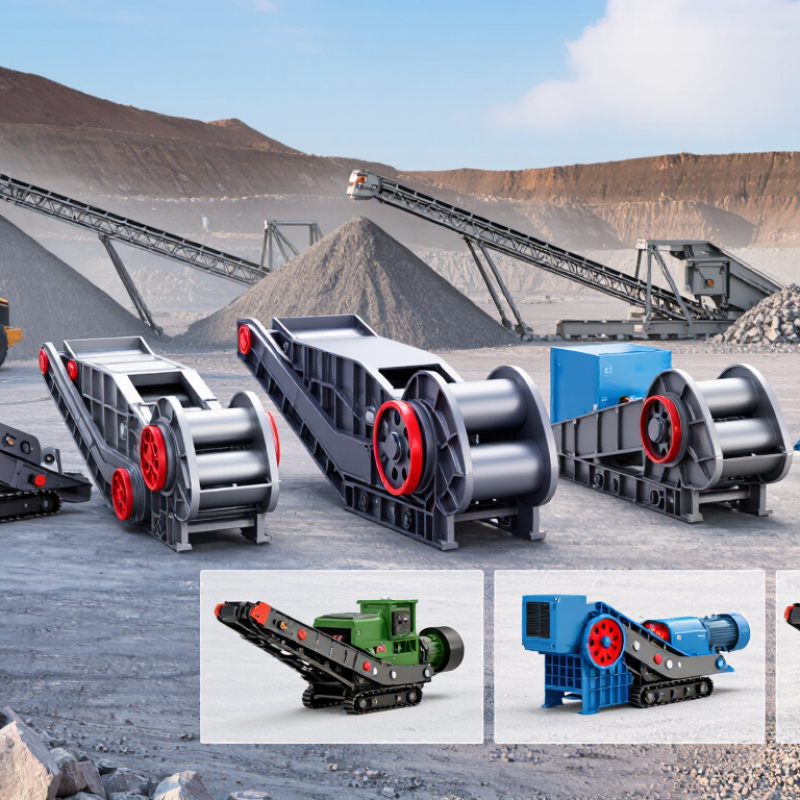
Selecting among seven leading rock jaw crusher options depends on feed size, output targets, and site conditions. In field assessments, a compact jaw crusher suits small contractors, recycling yards, and sampling work. A standard stationary crusher fits aggregate plants with steady production. Its fixed frame supports easier alignment and routine maintenance. A heavy-duty quarry crusher handles hard granite and large blasted rock. It needs strong foundations and controlled feeding.
A wheeled mobile jaw crusher offers quick relocation between short-term projects. It works well on road construction sites and remote aggregate deposits. A tracked mobile crusher performs better on uneven ground. Its crawler system reduces transport preparation, though undercarriage wear can increase costs. A diesel-electric jaw crusher supports flexible power management at isolated sites. Operators should check fuel use, generator compatibility, and local electrical requirements.
A hydraulic-adjusted jaw crusher allows faster setting changes and safer blockage clearing. It suits mixed production schedules and plants processing different materials. A laboratory or pilot jaw crusher serves universities, mineral testing facilities, and process-development teams. It provides controlled samples rather than high-volume output. I have seen buyers overestimate capacity while ignoring moisture, slab-shaped feed, and spare-part access. That mistake is expensive. Verify the closed-side setting, motor rating, steel quality, guarding, and service support before purchase. Actual performance can vary sharply with rock hardness and feeding discipline.
How to Evaluate Capacity, Durability, and Maintenance Needs
Choosing among the seven best rock jaw crushers requires more than comparing advertised tonnage. Capacity depends on feed size, rock hardness, moisture, and the closed-side setting. A crusher rated at 200 tonnes per hour may produce less with wet, flaky material. Request test data from similar stone, not only catalogue figures. Measure the actual feed opening, discharge range, and motor load.
Durability begins with the frame, jaw plates, bearings, and toggle system.
Thick wear parts can withstand abrasive granite, but they may increase replacement costs. Check plate thickness, manganese grade, bearing protection, and weld quality. Ask for inspection records and operating references from mines using comparable materials. Small design details matter. A sealed bearing is not maintenance-free.
Maintenance needs should match local skills and working conditions.
Look for tool access, clear lubrication points, simple hydraulic adjustment, and readable service intervals. Record liner wear weekly during the first month. This reveals real consumption better than a supplier estimate. Spare parts availability also affects downtime across borders. I once underestimated access space around a crusher; routine inspection became slow and unsafe. That mistake changed the evaluation method. Leave room for lifting equipment, dust control, and safe lockout procedures. Fancy controls cannot repair poor maintenance discipline.
Export, Installation, and After-Sales Factors for International Purchases
When comparing seven rock jaw crushers, international buyers should study export readiness, not only crushing capacity. Confirm the feed opening, discharge range, hourly output, and rock hardness. Ask for verified drawings, electrical requirements, and a complete packing list. Voltage, frequency, and motor protection may differ across countries. Small mismatches can delay commissioning.
Export documents deserve careful attention. Request the commercial invoice, packing details, certificate of origin, inspection records, and installation manual. Check whether wooden crates meet destination-country treatment requirements. Installation also needs practical planning. A level foundation, correct anchor bolts, safe access, and suitable lifting equipment reduce early failures. The supplier should provide foundation drawings and commissioning guidance. Do not guess. Remote video support can help, but it cannot replace qualified local technicians in difficult sites.
Tips: Put after-sales terms in writing. Confirm warranty coverage, response time, spare-parts availability, and technician costs before payment. Ask how quickly wear plates, jaw dies, bearings, and belts can be supplied. Request clear photos and serial-number procedures for troubleshooting. A low purchase price may become expensive when one wear part waits six weeks at customs. Buyers should also test communication before ordering. If technical answers arrive slowly or remain vague, future support may be worse. That concern is easy to overlook, and it deserves honest review.